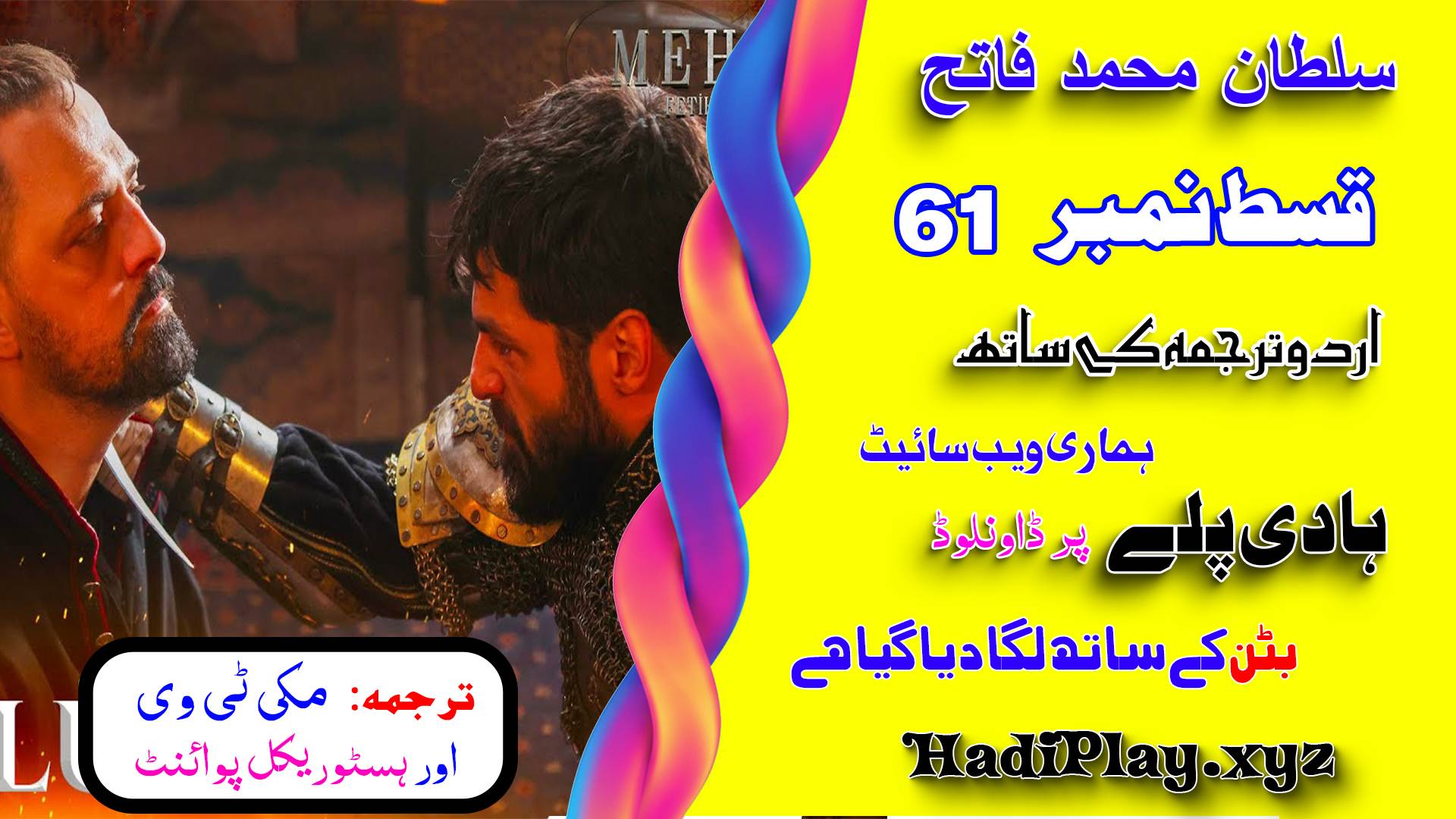
🚩 The Wounded Lion: Sultan Muhammad Fateh Episode 61—The Aftermath of Belgrade and The Price of Ambition 👑
Sultan Muhammad Fateh (Mehmed: Fetihler Sultanı) Episode 61 is a somber, introspective, and politically volatile episode that deals with the immediate fallout of the defeat at Belgrade. Following the catastrophic injury of Sultan Mehmed II and the chaotic retreat in Episode 60, this installment focuses on the fragility of power. It explores how a single military loss can threaten to unravel the authority of even the Conqueror of Istanbul.
The narrative shifts from the battlefield to the medical tent and the Divan, where the true war is now being fought: the war for the Sultan’s survival and the political survival of his aggressive war party. For the audience watching via Hadi Play, the Urdu Subtitles are crucial for navigating the hushed, tense whispers of the physicians and the sharp, accusatory rhetoric of the Viziers.
Part I: The Long March Home – Pain and Perception 🩸
Episode 61 chronicles the harrowing retreat from Belgrade to Sofia/Edirne. The army is demoralized, battered, and anxious about the fate of their leader.
The Sultan’s Physical Struggle
-
The Fight for Life: The episode opens with intense scenes inside the royal pavilion. The court physicians work desperately to treat the Sultan’s infected thigh wound. The tension is palpable; fever has set in, and Mehmed drifts in and out of consciousness. The Urdu subtitles capture the urgency of the medical terminology (Jarrah, Tiryaki) as they fight the infection.
-
The Theater of Strength: Despite his agony, Mehmed realizes that rumors of his death are spreading through the ranks, threatening to cause the army to disband or mutiny. In a moment of supreme willpower, he forces himself to stand, dress in his armor, and appear before his troops—if only for a few minutes—to prove he is alive. This act of suppressing pain for the sake of the state (Devlet) defines his character in this episode.
The Army’s Morale
-
The Silence of the Janissaries: The usually boisterous Janissaries are silent. They feel the shame of leaving the battlefield without victory. The episode visually contrasts the glorious march to Belgrade with the limping, silent march away from it.
-
The Pursuit: John Hunyadi does not pursue vigorously, but his light cavalry harasses the Ottoman rear guard. This forces the commanders to maintain discipline even in defeat, turning the retreat into a fighting withdrawal.
Part II: The Court of Accountability – The Purge of the Hawks 🦅
With the army safe in Edirne, the political knives come out. Defeat requires a scapegoat, and the target is clear.
The Trial of Zaganos Pasha
-
The Blame Game: Mahmud Pasha and the old guard (the remnants of the peace faction) launch a blistering political attack on Zaganos Pasha. They argue that Zaganos’s arrogance, his dismissal of the naval risks, and his aggressive push for the siege caused the disaster. They frame the defeat not as the Sultan’s failure, but as Zaganos’s misguidance.
-
The Sultan’s Verdict: Mehmed is forced to make a difficult choice. He values Zaganos’s loyalty and aggressive spirit, but he cannot ignore the reality of the failure. The episode likely concludes with the dismissal or exile of Zaganos Pasha from the Grand Vizierate. This is a massive political shift, signaling a temporary return to more cautious policies.
The Rise of the Critics
-
The Voice of Dissent: The defeat emboldens the Sultan’s critics within the Ulema and the noble families. They whisper that perhaps the conquest of Constantinople was a fluke, or that Mehmed has lost “Divine Favor” (Kut). Mehmed listens to these whispers from his sickbed, fueling a cold, simmering rage that will drive his future reforms.
Part III: The Bells of Noon – The European Celebration 🔔
While the Ottomans mourn, Europe celebrates.
-
The Papal Decree: The episode shifts to Rome and Buda, where the victory is hailed as a miracle. The Pope orders the ringing of church bells at noon (a tradition that continues to this day) to commemorate the victory at Belgrade. This sound acts as a psychological torment to Mehmed, reminding him of his failure.
-
The Plague in the Victory: However, the celebration is short-lived. The episode foreshadows the grim reality hitting the Hungarian camp: the unburied bodies at Belgrade have triggered a plague. John Hunyadi, the victor, falls ill. The episode suggests that while the Ottomans lost the battle, nature may claim the winner, leaving the Balkans leaderless once again.
Part IV: Cultural Context and Translation Imperatives 🌍
Episode 61 is a heavy, dialogue-driven drama that relies on the nuances of shame, honor, and accountability.
The Critical Role of Urdu Subtitles
The Urdu Subtitles provided by Hadi Play are indispensable:
-
The Language of Defeat: The subtitles capture the subtle difference between Shikast (military defeat) and Zillat (humiliation). Mehmed accepts the former but refuses the latter.
-
Medical Urgency: The scenes involving the Sultan’s surgery and fever dreams rely on specific medical and spiritual terms (Shifa, Dua) that frame his recovery as a divine test.
-
Political Rhetoric: The arguments in the Divan are sophisticated. The subtitles clarify how Mahmud Pasha uses “prudence” as a weapon to destroy Zaganos Pasha, translating the high-court insults and maneuvers effectively.
Thematic Conclusion
Sultan Muhammad Fateh Episode 61 ends not with a bang, but with a silent vow. As Mehmed recovers, he studies the maps of the Balkans. He realizes that his army, his navy, and his laws must be completely reformed. The defeat at Belgrade does not break him; it creates the ruthless, efficient system that will define the rest of his reign. The lion is wounded, but he is learning.
Frequently Asked Questions (FAQs) about Sultan Muhammad Fateh, Episode 61:
| Question | Answer |
| Q1: What is the main focus of Episode 61? | A1: The episode focuses on the aftermath of the defeat at Belgrade, the Sultan’s recovery from his severe wound, and the political fallout within the Ottoman court. |
| Q2: Does Sultan Mehmed die in this episode? | A2: No, but he is critically ill from an infected wound. He must force himself to appear strong to prevent mutiny and quell rumors of his death. |
| Q3: What happens to Grand Vizier Zaganos Pasha? | A3: Zaganos Pasha is blamed for the failure of the siege. He faces intense political attacks from rivals like Mahmud Pasha and is likely dismissed or exiled by the Sultan. |
| Q4: How does Europe react to the Ottoman retreat? | A4: Europe celebrates the victory as a miracle, with the Pope ordering the ringing of noon bells. However, the Hungarian camp is soon struck by a plague, threatening their commander Hunyadi. |
| Q5: Why are Urdu Subtitles important for this episode? | A5: Subtitles are crucial for understanding the political maneuvering in the Divan as the Viziers blame each other, and the emotional dialogue of the Sultan as he processes his first major defeat. |