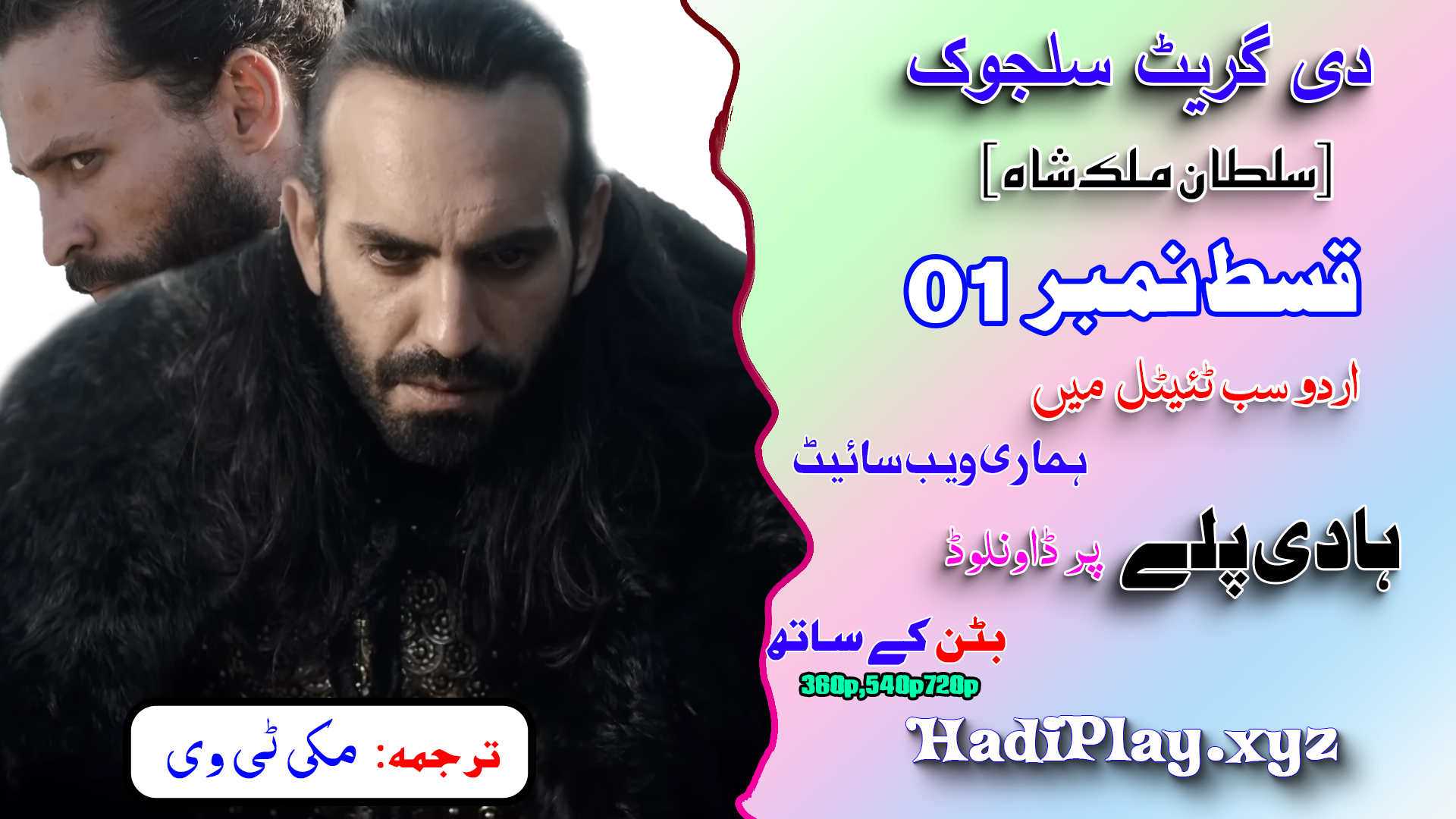
 The Great Awakening: The Great Seljuk Episode 1—The Birth of a Legend and The Shadow of Sabbah
The Great Seljuk (Uyanış: Büyük Selçuklu) Episode 1 is a spectacular historical premiere that immediately immerses the audience in the complex, expansive world of the 11th-century Great Seljuk Empire. This episode is far more than an introduction; it is a highly tense political thriller focused on Sultan Melikşah’s (Malik Shah) struggle to maintain the stability of his vast realm against both internal political decay and the revolutionary, existential threat of the Hashashin (Assassins), led by the formidable intellectual Hasan Sabbah. The episode sets the standard for the series’ immense production quality and its deep dive into the ideological conflict between Order (Nizam) and Anarchy (Batiniyya).
For the vast Urdu-speaking audience, the availability of high-quality Urdu Subtitles is absolutely paramount for this specific episode. The premiere is dense with historical context, military terminology, complex titles (Vizier, Atabey), and philosophical debates. The subtitles act as a crucial educational and emotional bridge, ensuring the audience fully grasps the immense administrative challenges faced by Nizam al-Mulk and the specific ideological poison preached by Sabbah, which is the true engine of the series’ drama.
Part I: The Seljuk Zenith and the Crisis of Leadership 
Episode 1 establishes the Seljuk Empire at its height—a powerful cultural and military force stretching across Asia Minor and the Middle East—but immediately reveals the profound vulnerabilities inherited by its ruler.
Sultan Melikşah: The Burden of the Crown
The protagonist, Sultan Melikşah (historically Malik Shah I), is introduced not as a purely triumphant conqueror, but as a ruler grappling with the overwhelming administrative burden of an empire founded on the unity of fiercely independent Turkic tribes.
-
- The Problem of Scale: The sheer size of the empire—its diverse subject populations, disparate religious groups, and independent-minded Beys (nobles)—means that centralized control is incredibly fragile. Melikşah’s reign is defined by the constant need to impose the Law of the State (Nizam) over the decentralized law of the tribes. This subtle but critical political conflict is often articulated in the Sultan’s court dialogues, making the Urdu Subtitles essential for translating the political nuance.
-
- The Shadow of Alparslan: Melikşah constantly operates under the shadow of his father and predecessor, Sultan Alparslan, the hero of the Battle of Manzikert, who secured the Seljuks’ entry into Anatolia. Melikşah’s task is harder: not conquest, but consolidation and construction.
The Grand Vizier: Nizam al-Mulk
The intellectual and administrative backbone of the Seljuk state, Grand Vizier Nizam al-Mulk (whose name literally means “Order of the Realm”), is introduced as the key political figure.
-
- The Architect of Order: Nizam al-Mulk is portrayed as the quintessential scholar-statesman. He is the architect of the empire’s educational system (Madrasas), its intricate bureaucracy, and its complex system of governance. His relationship with the Sultan is one of deep loyalty and political necessity; the Sultan holds the military power, but the Vizier holds the institutional knowledge.
-
- The Philosophical Conflict: The Vizier embodies the principles that Hasan Sabbah despises: law, structure, and orthodox Sunni theology. The series premiere immediately establishes Nizam al-Mulk’s profound wisdom and his agonizing awareness of the empire’s internal weaknesses.
The Dynastic Secret and Sencer’s Introduction
The episode introduces the central dramatic secret that will drive the season’s personal narrative.
-
- Başulu Hatun and the Sacrifice: The plot reveals that Sultan Melikşah has a secret son, Sencer, born to his first love, Başulu Hatun. Due to political circumstances—likely an internal threat or a rival’s manipulation—Sencer’s life had to be concealed, forcing him to be raised in obscurity, away from the corrupting influences of the court.
-
- Sencer the Hero: Sencer is introduced as a highly skilled, fiercely righteous warrior operating on the frontier, unaware of his royal lineage. His actions are governed by pure Adalet (Justice), a character trait that makes him the perfect, untainted weapon against the court’s treachery and the enemy’s ideological decay.
Part II: The Ideological Adversary – Hasan Sabbah and the Hashashin 
Episode 1 dedicates significant time to introducing the Seljuk’s most existential threat: Hasan Sabbah and the Batiniyya/Hashashin network.
The Enemy as Philosophy
Hasan Sabbah is immediately presented not as a mere military rival or a political insurgent, but as a philosophical and ideological revolutionary seeking to dismantle the foundations of Sunni Islam and the Seljuk state.
-
- The Infiltration: The episode showcases the terrifying effectiveness of the Hashashin’s network. They successfully orchestrate a major act of sabotage or a high-profile assassination attempt against a critical Seljuk asset (a scholar, a Bey, or perhaps a provincial governor). This attack serves to prove that the enemy can strike anywhere, shattering the illusion of security in the capital.
-
- The Promise of Anarchy: Sabbah’s ideology is explored through his intellectual rhetoric. He preaches that the Sultanate is corrupt, that the orthodox Ulema are liars, and that true salvation can only be found through his interpretation of faith, often using the promise of martyrdom and paradise to create fanatically loyal agents. This ideological poisoning is what Nizam al-Mulk fears most, making the Urdu Subtitles essential for translating Sabbah’s corrosive and manipulative rhetoric.
The Catalyst for Conflict
The premiere creates the definitive spark for the season’s core mission:
-
- The Stolen Relic/Document: The Hashashin’s successful operation results in the theft of a vital state document, a religious relic, or a highly sensitive map that could compromise Seljuk military movements or its diplomatic standings. The retrieval of this item becomes Sencer’s first critical mission, thrusting him from obscurity into the shadow war.
-
- The Vizier’s Call to Arms: Nizam al-Mulk, realizing the conventional military is useless against this clandestine threat, initiates a secret counter-intelligence force, recruiting individuals outside the known bureaucracy—a strategy that naturally leads him to Sencer. The Vizier must convince Melikşah that this enemy requires a new kind of defense.
The Karakhanid and Byzantine Axis
To emphasize the multi-front war, the episode reveals that Sabbah’s Batiniyya is already forging alliances with external enemies.
-
- Treason on the Borders: The Karakhanid Khanate (a Turkic rival) or the Byzantine Tekfurs (governors) are shown secretly dealing with Hashashin agents, providing them with intelligence or safe passage. This confirms that the Seljuk crisis is being actively exploited by both internal and external foes. The urgency of this multi-pronged attack is clearly transmitted via the subtitles.
Part III: The Visual Epic and Subtitle Context 
The success of The Great Seljuk with the global audience is rooted in its immense production scale and the effective localization through Urdu Subtitles.
Cinematic Grandeur
-
- Visual Scope: Episode 1 immediately establishes the show’s massive budget. The cinematography captures the sweeping vistas of the Seljuk domains, contrasting the gilded Isfahan Palace (the Seljuk capital) with the harsh, wide-open Anatolian frontiers.
-
- Battle Choreography: The action sequences are large-scale, detailed, and historically authentic, showcasing the Seljuk cavalry’s power and discipline. The visual language emphasizes the formal, heavy, mail-clad military structure of the Sultanate, contrasting sharply with the smaller, more agile nature of the Hashashin cells.
The Crucial Role of Urdu Subtitles
For the vast Pakistani and South Asian audience, the Urdu Subtitles are not optional, but essential for engaging with the depth of the premiere.
-
- Terminology Accessibility: The Seljuk Empire’s hierarchy is filled with specific titles—Melik (Prince), Atabey (Mentor), Hacib (Chamberlain), and Vezir (Vizier). The subtitles ensure these highly specific ranks and titles are immediately clear, allowing the audience to focus on the political alliances rather than confusing terminology.
-
- Translating Philosophical Weight: The most complex scenes involve Nizam al-Mulk’s consultations with the Ulema (scholars) on combating the Batiniyya. The subtitles must accurately translate the theological and legal arguments used to justify the war against Sabbah’s ideology. This translation ensures the audience understands that the core of the conflict is intellectual and spiritual, not merely territorial.
-
- Subtext and Court Protocol: The palace scenes involve intense, subtle political maneuvering, particularly by Terken Hatun, the Sultan’s powerful wife. Her veiled threats and coded political language are fully accessible through well-timed and accurate Urdu Subtitles, helping the audience track the dangerous internal power dynamics.
Frequently Asked Questions (FAQs) about The Great Seljuk Episode 1:
| Question | Answer |
| Q1: Who are the three central figures introduced in the premiere? | A1: The central figures are Sultan Melikşah (the ruler), Nizam al-Mulk (the Grand Vizier), and Sencer (the Sultan’s secret son and hidden hero). |
| Q2: What is the primary existential threat established in Episode 1? | A2: The threat is the Hashashin (Batiniyya) network led by Hasan Sabbah, who seeks to dismantle the Seljuk Empire through highly sophisticated political assassination and ideological infiltration. |
| Q3: What immediate crisis does the Hashashin network orchestrate in the premiere? | A3: They orchestrate the theft of a critical state document or relic, forcing the Vizier to form a secret counter-intelligence unit to retrieve it, which is Sencer’s first mission. |
| Q4: Why are Urdu Subtitles crucial for the audience of this episode? | A4: Subtitles are vital for translating the highly specialized Seljuk administrative titles (Vizier, Atabey), the philosophical dialogue of Hasan Sabbah, and the complex internal court protocol used by Terken Hatun. |
| Q5: What institutional strategy does Nizam al-Mulk prioritize to fight the Hashashin? | A5: He prioritizes an ideological and structural defense, relying on the integrity of the Madrasa system and the rule of law (Nizam) rather than purely military action. |